If the decree is ratified, from 1 December stays of 30 nights or fewer at holiday rentals in Spain would carry 10% VAT. Simulate in a minute what it would cost you and how much you would need to raise your rate to stay where you are.
Simulation · pending ratification
Royal Decree-law 29/2026, published in Spain’s Official State Gazette (BOE) on 7 October. It still has to be ratified by the Spanish Parliament: until then, this is a simulation. Updated 21 October 2026.
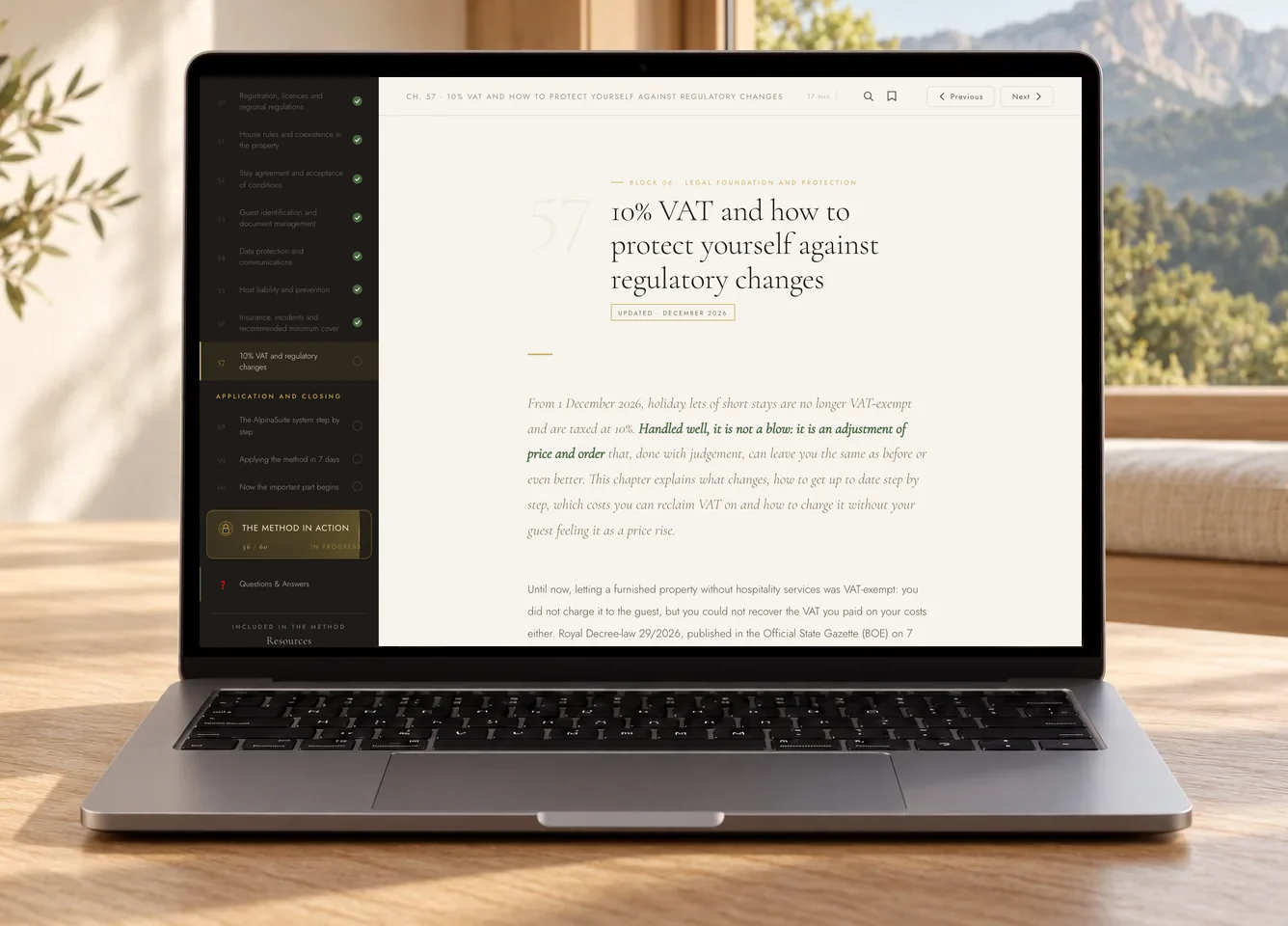
This is how chapter 57 of the Method looks with VAT. It arrives with the update, as soon as the decree is ratified.
Your numbers, night by night
Enter today’s figures and you will see where each euro of a night would go if the 10% applies, and what it would mean for your year.
Your figures for the year
€
nights
€ a year
Cleaning, laundry, electricity, water, internet, replacements, maintenance, accountant and furniture. Property tax (IBI), community fees and insurance carry no VAT: leave them out.
Where you sell
%
If you sell on several, enter the average.
An estimate, before income tax. VAT on costs is estimated at 21% and could only be recovered with an invoice in your name. It is compared with your situation today: exempt and paying VAT on the commission. Your figures stay on this device.
Your €110 night, with 10% VAT
—would be yours
—VAT, inside the price
—you would recover from the VAT on your costs
—what would really go to the tax agency
Over your year, VAT would cost you
—
To stay where you are, you would raise by
—
The same drawing as the illustration in chapter 57 of the Method, with your numbers.
Now you have the figure. What you would do with it will be in the Method.
The AlpinaSuite Method has its VAT update ready and switches it on the day the Spanish Parliament ratifies the decree: chapter 57 explains registration, pricing and invoices step by step, and the tools work with the 10%. Buy it now and the update is included. And if the decree is not ratified, you will have nothing to change: you stay exempt and the Method is already up to date with the current rules. This is what you will see inside.
Advanced Profitability Calculator
Your full return, with VAT
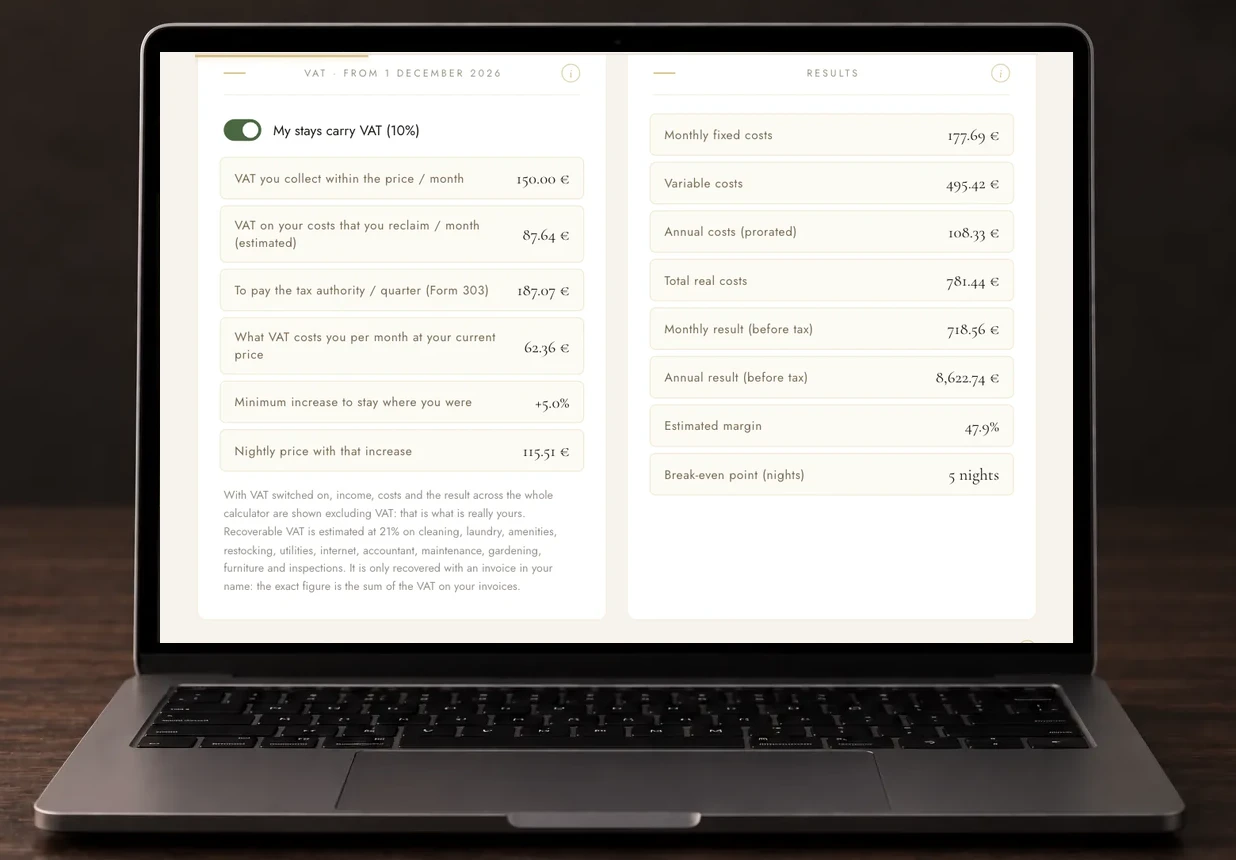
Tick one box and the whole calculator works net of VAT: what you charge, what you recover, what you pay each quarter and your new nightly rate. Contracts also come out with the breakdown.
60 chapters and every tool, with the VAT update included.€39 VAT included, a single payment and instant access. By purchasing you accept the Terms of Sale.
If the decree is ratified: who it would affect, how it would be calculated, which costs you would recover and what you would need to do with the Spanish tax agency before your first booking with VAT.
What would change and who it would affect
Today, renting out a furnished home without hotel-type services is exempt from VAT in Spain: you do not charge it, but you cannot recover the VAT you pay on your costs either. Royal Decree-law 29/2026 would change that rule: if it is ratified, from 1 December 2026 every stay of 30 nights or fewer with the same guest would be taxed at 10%, whether you run it as a private individual or as a company, and from the very first booking. The decree sets no income threshold below which you would be left out.
Would carry 10%
Holiday flats and tourist-use homes
Country houses let as a whole
Stays of 30 nights or fewer
The cleaning fee and extras
Would stay exempt
Stays of more than 30 nights
Mid-term rentals
Rooms in your own main home
Nothing would change
If you already provide hotel-type services: you are already taxed at 10%
The decree was published in the BOE on 7 October and is pending ratification by the Spanish Parliament. If it is ratified, the 10% would apply from 1 December; if not, everything would stay as it is now.
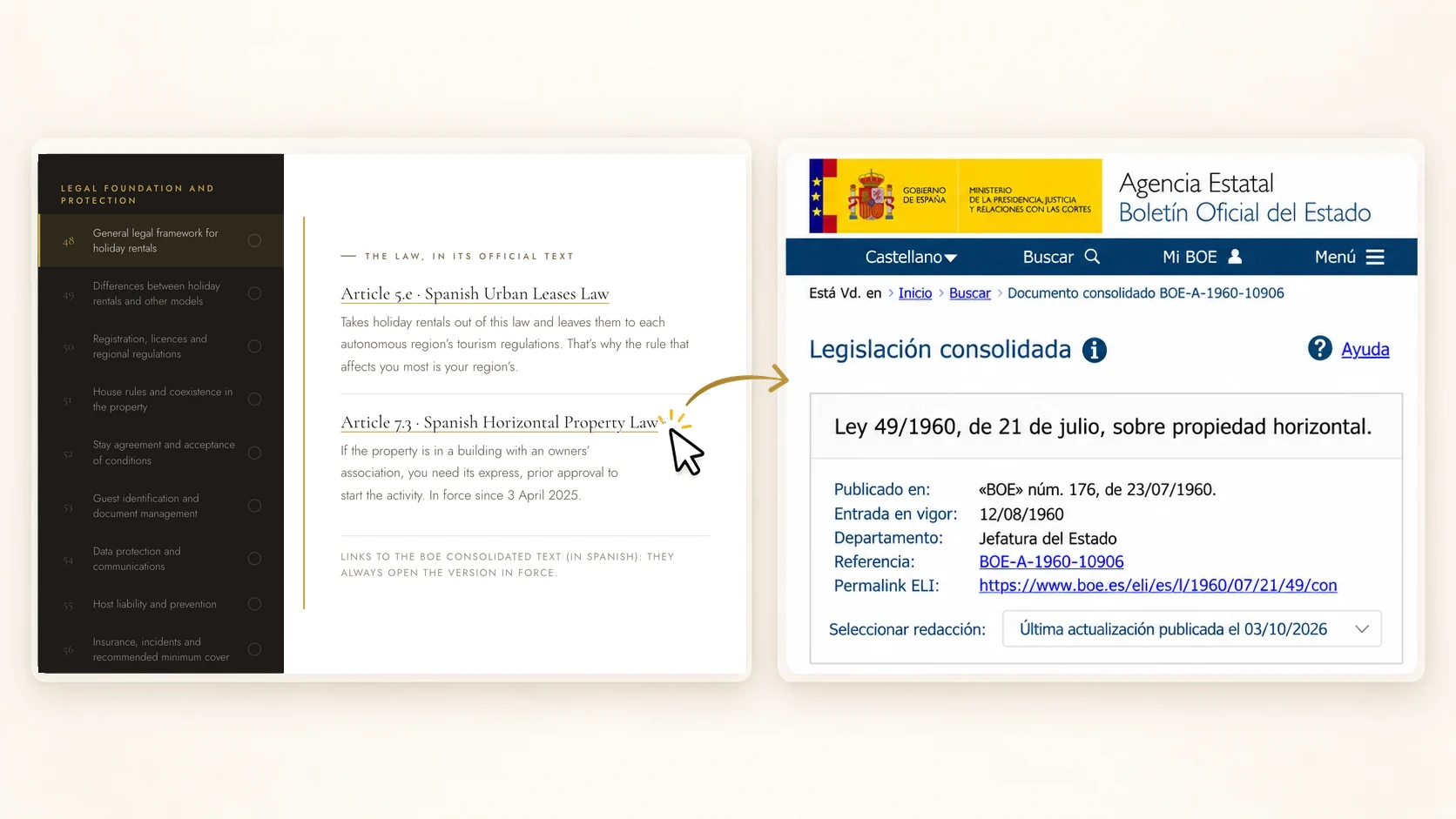
In the Method, every law links to its official text in the BOE.
How the VAT on your rental would be calculated
The law requires you to show guests the final price, taxes included. So the VAT would go inside the price you publish: it would not be added on at the end.
Net = price with VAT ÷ 1.10 · VAT = price with VAT − net
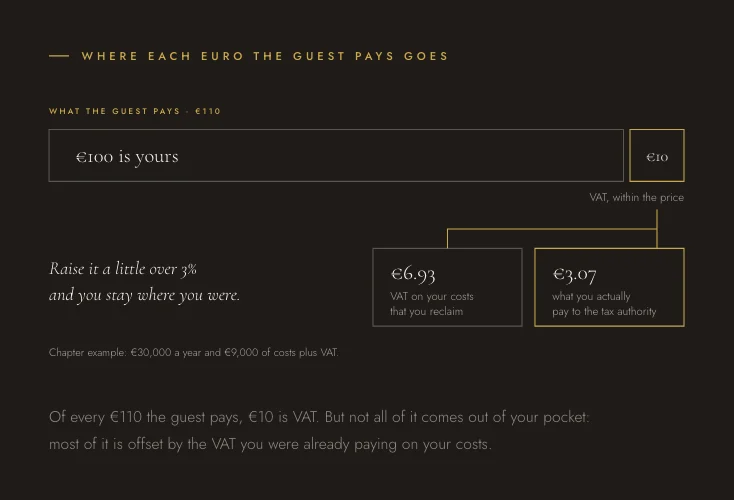
Of a €110 night, €100 would be yours and €10 would be VAT. But not all of that VAT would come out of your pocket: you would subtract the VAT you pay on your costs. For a property that turns over €30,000 a year with €9,000 of costs plus VAT, you would recover €6.93 of that €10 and €3.07 would go to the tax agency.
The illustration in chapter 57 of the Method. The calculator above draws it with your numbers.
That is why, in this example, raising your rate by just over 3% would leave you exactly where you are today. The more you invest in your property, the less you would need to raise it.
The costs you could deduct
This would be the good side of the change. What today is a cost with no way back would become recoverable every quarter, as long as you have an invoice in your name with your tax number (NIF). A receipt without your details would not count.
Would be deductible
Contracted cleaning and laundry
Electricity, water, gas and internet
Bed linen, kitchenware and amenities
Furniture and appliances
Refurbishment and maintenance
Accountant and software
Would not be deductible
Property tax (IBI) and waste charge
Insurance
Community fees
Mortgage interest
Buying a second-hand home (it pays transfer tax, ITP)
Watch out
If you use the home yourself for a few weeks, only the rental share
If you mix short and long stays, the pro-rata rule would apply
If you are planning to change mattresses, refresh the decor or refurbish, and the decree is ratified, doing it after you register would save you that VAT directly.
Airbnb, Booking and the commission that would get cheaper
What hardly anyone explains: if you are not registered, Airbnb charges you 21% VAT on top of its commission. A 15.5% fee becomes almost 18.8% of your turnover.
Register for the ROI and add your EU VAT number to the platform, and that VAT would disappear.
The ROI is Spain’s Register of Intra-Community Operators. You would apply for it on the same form 036 and it would give you your tax number with the ES prefix. Airbnb invoices from Ireland and Booking from the Netherlands: as soon as they validate your number, they stop charging you that VAT. You would declare it and deduct it on the same form, so it would cancel out. For a property that turns over €30,000 a year, that would be almost €1,000 you stop paying.
What you would need to do with the tax agency
If the decree is ratified, these would be the steps:
Register the activity, form 036Before 1 December
Heading 861.1 if you only rent, 685 if you provide servicesOn the same 036
Register for the ROI, if you sell through platformsOn the same 036
An invoice for each stay, simplified up to €400For every booking
Form 303: VAT charged minus VAT recoveredEvery quarter
Form 349, if you are on the ROIWith the 303
Your first 303, covering December only, would be due by 30 January 2027; after that, by 20 April, July and October. If you are a private individual, the business activity tax (IAE) would cost you nothing: you are exempt. And registering for VAT would not on its own make you self-employed (autónomo): that depends on whether the activity is your usual occupation and whether you provide hotel-type services. If you only rent, you would normally not file the annual summary (form 390): the annual section of the fourth-quarter 303 would be enough.
The bookings you have already sold
The decree brings no special rule, so the general rule of the Spanish VAT Act would apply (Article 75): VAT arises when the stay takes place, but if you are paid in advance, it arises on payment and on the amount paid.
Stay from 1 December, paid from that date10%
Stay from 1 December, paid in full beforeExempt
Deposit before, balance afterDeposit exempt, balance at 10%
With platforms it is not clear which date counts as your payment. If it is ratified and you want to be on the safe side, apply 10% to every stay from 1 December.
Will I have to charge VAT on my holiday rental in Spain from 1 December 2026?
If the decree is ratified, yes, for stays of 30 nights or fewer. Royal Decree-law 29/2026 would remove the exemption and tax them at 10% VAT from 1 December 2026, whether you are a private individual or a company and from the very first booking. As of today it is pending ratification by the Spanish Parliament.
Would VAT on holiday rentals in Spain be 10% or 21%?
10%. A 21% rate was discussed in June, but what Royal Decree-law 29/2026, pending ratification, sets out is the reduced 10% rate, the same as hotels.
Would it affect rentals of more than 30 nights?
No. Stays of more than 30 nights, mid-term rentals, would remain exempt. So would rooms you let in your own main home.
Would I have to become self-employed (autónomo) to charge VAT?
Not necessarily. If the decree is ratified, you would have to register with the Spanish tax agency on form 036 before your first stay with VAT, but that would not on its own make you self-employed for Social Security purposes: it depends on whether the activity is your usual occupation and whether you provide hotel-type services. If you are a private individual, you would not pay the business activity tax (IAE) either.
Would Airbnb or Booking charge the VAT for me?
No. The platform charges the guest the price you publish, but you would declare the VAT on the stay yourself every quarter on form 303. That is why the price you publish would have to include it already.
How much would I need to raise my rate so I do not lose money?
Much less than 10%, because you would recover the VAT on your costs and, with the ROI, the platform would stop charging you VAT on its commission. For a property that turns over €30,000 a year with €9,000 of costs plus VAT, just over 3% would be enough. The calculator gives you your exact figure.
What would happen to the bookings I already have for December?
Article 75 of the Spanish VAT Act would apply: if the stay is from 1 December and you are paid from that date, it would carry 10%. Anything paid before, when the stay was exempt, would remain exempt. With platforms it is not clear which date counts as payment: the safest option would be to apply 10% to every stay from 1 December.
Has VAT on holiday rentals in Spain been approved?
Not yet. Royal Decree-law 29/2026 was published in the Official State Gazette (BOE) on 7 October 2026, but the Spanish Parliament still has to ratify it. If it does, the 10% would apply to stays of 30 nights or fewer from 1 December 2026; if not, everything would stay as it is now. This calculator is a simulation until that day.
Cookies
We look after every detail,including the ones you can't see.
We use our own and third-party cookies to measure and improve your experience. You decide: you can accept or reject them, and if you say no, we won't activate any tracking. We explain everything in our Cookie Policy.